Showing posts with label Headphones. Show all posts

Thursday, 3 January 2019

Auna AV2-CD508BT Hi Fi Amplifier to High End Preamplifier AUX bluetooth


How to made an economic High End Preamplifier.

My Auna CD508 project: from Hi Fi power amplifier to High End Preamplifier with Phono MM and MC.
The original amplifier has a switching power supply, the input selector is made by CD4052 and power amplifier is made by Texas Instruments AB class IC, LM1875 in bridge connection. The power rails voltage are +16/0/-16 Vdc and it as some features like tone control, BT connection balance, remote control , motorized volume knob, output relay, 3 inputs(4 with BT) , a tape recording output and a headphones out.
Estimated  power output on 8ohm should be around 50W/CH.
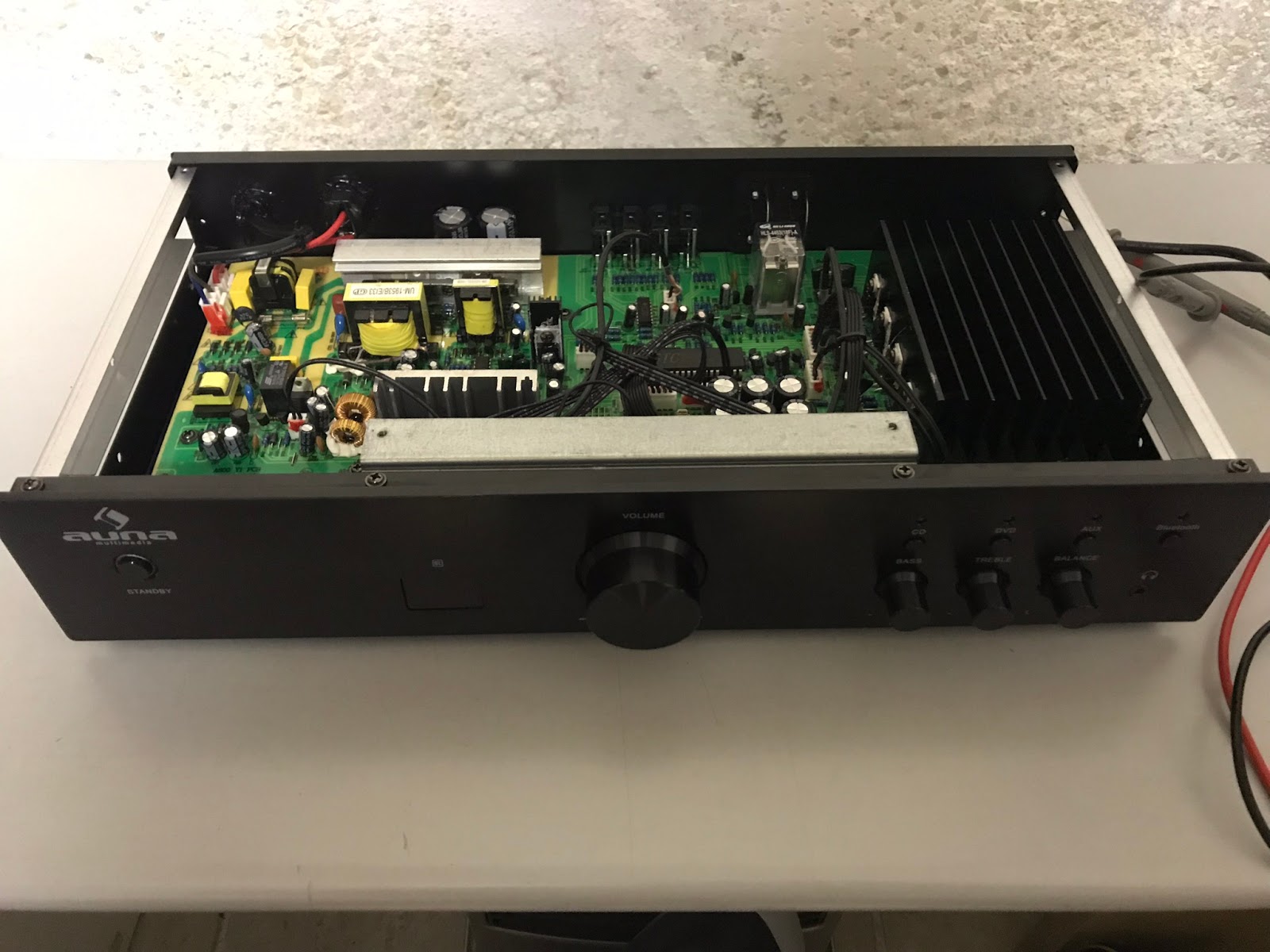
Amplifier Auna AV2-CD508BT before mod

I dismounted the power amplifier section and I made a substitution with my Espritaudio Preamplifier modules: ESPRE

Preamplifier Auna AV2-CD508BT after mod


Bridge connection of LM1875


Monday, 19 November 2018

The ultimate real analog synth for everyone UNO Synth


UNO Synth

IK multimedia combined his two decades of experience in software and hardware development with the expertise of Italian boutique synth-maker Soundmachines and IK’s synth guru, Erik Norlander (one of the brains behind acclaimed synths like the Alesis Andromeda).


UNO Synth editor

Advanced synth control for Mac/PC and iOS

The UNO Synth Editor is a plug-in and standalone app that lets you access all the parameters of IK’s groundbreaking UNO Synth, the real analog synthesizer for everyone. The Editor lets you go beyond the front panel controls and access deeper programming settings like full 4-stage ADSR envelopes for both filter and amplitude, pulse width and waveform shape modulation of the oscillators, modulation wheel assignments, velocity control and much more. The Editor does not make sound on its own. Rather, it is a controller for the UNO Synth hardware that gives you remote control of this innovative instrument from your computer or mobile device.

UNO Synth editor Mac/PC iPhone/iPad


Tuesday, 16 June 2015

DIY DC/DC Dual Boost regulated Power Supply for High Voltage Tube VAS


In relation to DIY Hybrid amplifer the first step is to obtain the High Voltage for tube's anode supply and the low voltage for heaters.

Sometimes, if not always, fora a 100W amplifier you have a double sec 150-300VA  36-0-36Vac power transformer only.
Using this board you can adjust the  needed voltage for tube stage starting from your transformer.
Without use any voltage doubler and linear regulators.


The Following image shows how the Double Boost works.
From unregulated  +55/0/-55Vdc the circuit gives at his output the needed voltage, able to supply the anode current for a tube stage.
For example you can obtain +90/0/-90Vdc and 6.3Vdc for the heaters..


Friday, 5 June 2015

DIY Do It Yourself KIT Headphones Hibryd 0fb Class A Tube Amplifier Using Boost Coverter Power Supply DC DC Coverter output 190Vdc 6.3Vdc starting from 12-24Vdc


Zero Feedback 100mW Hi Fi Tube - BJT Amplifer using Hi Voltage Power Supply by DC DC Boost Converter.

Boost and Buck Board provide to give:

VAS Tube Supply: 190Vdc
Curret Buffer Amplifer Supply: 30Vdc
Heater voltage 6.3Vdc by Step Down converter

All voltages obtained starting from 12-24Vdc power supply, as Desktop power supply or Battery


DC DC Step Up and Step Down Board


Monday, 31 March 2014

"Operazione Goodnight" Tube & BJT Hybrid Class A Headphones Amplifier Project Schematics Layers SMPS Power Supply


My Goodnight Tube Headphone Project Schematics  
SMPS Power Supply 

Triode Amplifier Section ECC82 ( 12AU7)

Voltage Tube Amplifier Stage Schematic

Class A BJT Emitter Follower Current Buffer 
2SC2238 2SA968 
2SC1815 2SA1015
LM334Z
Current Buffer Stage Schematic


Top Layer and Components Amplifier Section


Switching Power Supply Based on Texas Booster Driver IC LM3478 and Buck IC LM22673.

Vin=12Vdc
Vout1=200Vdc
Vout2=30Vdc
Vout3=6.3Vdc

 Top Layer:

SMPS Buck-Boost


Tuesday, 18 March 2014

"Operazione Goodnight" Headphones Amplfier Using Vacuum Tube ECC82 ( 12AU7)


My  Project about a Vacuum Tube Headphones Amplifer for my Philips Fidelio X1:


My Tube Amplifier and My Headphones Philips


My Headphone Tube Amplifier 
Tube used for amplifier is a ECC82/12AU7 followed by a discrete Class A BJT Buffer
The First One mede uses ELNA Cerafine Audio Capacitors.
The Power Supply is my Board made by a mix of  Bust and Buck Switching Converters from main 12-24Vdc
So  From DC Supply we can obtain: 200Vdc for Tube circuit, 30Vdc for Buffer Circuit, 6,3Vdc 


"Goodnight" Powe Supply Board 

Switching Board with IC, Mosfet and Audio Board with Philips Miniwatt NOS ECC82  12AU7

NOS ECC82 Philps Miniwatt and Switching Power Suupply Board


Headphone Amplifier complete with a White Led on the base of Tube

TUBE

The Second One uses ELNA Audio Silmic II Capacitors

The Second One With ELNA Silmic II Audio Capacitors
 Boards and Headphones


Friday, 14 June 2013

DIY Headphone Hybrid Amplifier Schematic Simulation


To semplify last project I choose to exchange Current Generator by a simple Resistor.
Power dissipate is about 4W so this component, 60ohm, shoul be composed by 2x120ohm/5W resistors.

Semplified schematic

Distortion increase, third harmonic

Distiortion increase, Vin=1Vpk, Vout=5Vpk but the power on the Haedphone is 400mW near the maximun power admitted, 500mW.

At 3Vpk out:


3Vpk output


Friday, 7 June 2013

Hybrid Headphones Amplifier Project, ECL82 (6BM8) plus Power BJT for 32ohm Philips Fidelio X1 With Tube Distortion


I'm looking for an Amplifier to drive my new 32 ohm impedence Philips Fidelio X1 Headphones.

My personal project is illustrated below:
Static Voltages
I would have a tipical Tube Distortion, I choose ECL/PCL to drive a Big BJT witjout other BJT drivers, not only 2SC3281, maybe I'll use 2SC2337 I bought from GB but potential fake....
Q3 should be change by 2 diode 1N4148 with related R25 value.
The amplifier factor should be not high, here is 5, there is no overall negative feedback.
Below the Simulation of distortion with V2(Vin)=1Vpk, V(R6)(Vout)=5Vpk F=1kHz

Second armoni c distortion for: V2(Vin)=1Vpk, V(R6)(Vout)=5Vpk F=1kHz

Static Currents


HeadPhones Amplifier Bandwidth


I hope I'll make it soon...